Machine learning in finance differs from traditional financial modeling in one crucial way: traditional models begin with assumptions about how markets work, while machine learning focuses on discovering relationships directly from data and judging success through predictive performance.
One of the easiest mistakes to make in modern finance is assuming that machine learning is simply a more advanced version of traditional statistical modeling. On the surface, both use data, both generate predictions, and both help analysts make decisions.
The deeper difference is philosophical. The two approaches begin from different assumptions about how knowledge should be extracted from financial data. Understanding that distinction helps explain why they often produce different insights, even when analyzing the same market.
For analysts, students, and investors trying to make sense of modern quantitative finance, this difference matters far more than learning a particular algorithm or formula.
Takeaways
- Traditional financial modeling typically starts with a predefined hypothesis about how variables are related.
- Machine learning focuses on finding relationships directly from data rather than assuming them beforehand.
- Traditional models often emphasize model fit and validation, while machine learning emphasizes predictive accuracy on unseen data.
- Neither approach is universally better; each works best under different conditions.
The Traditional Modeling Mindset
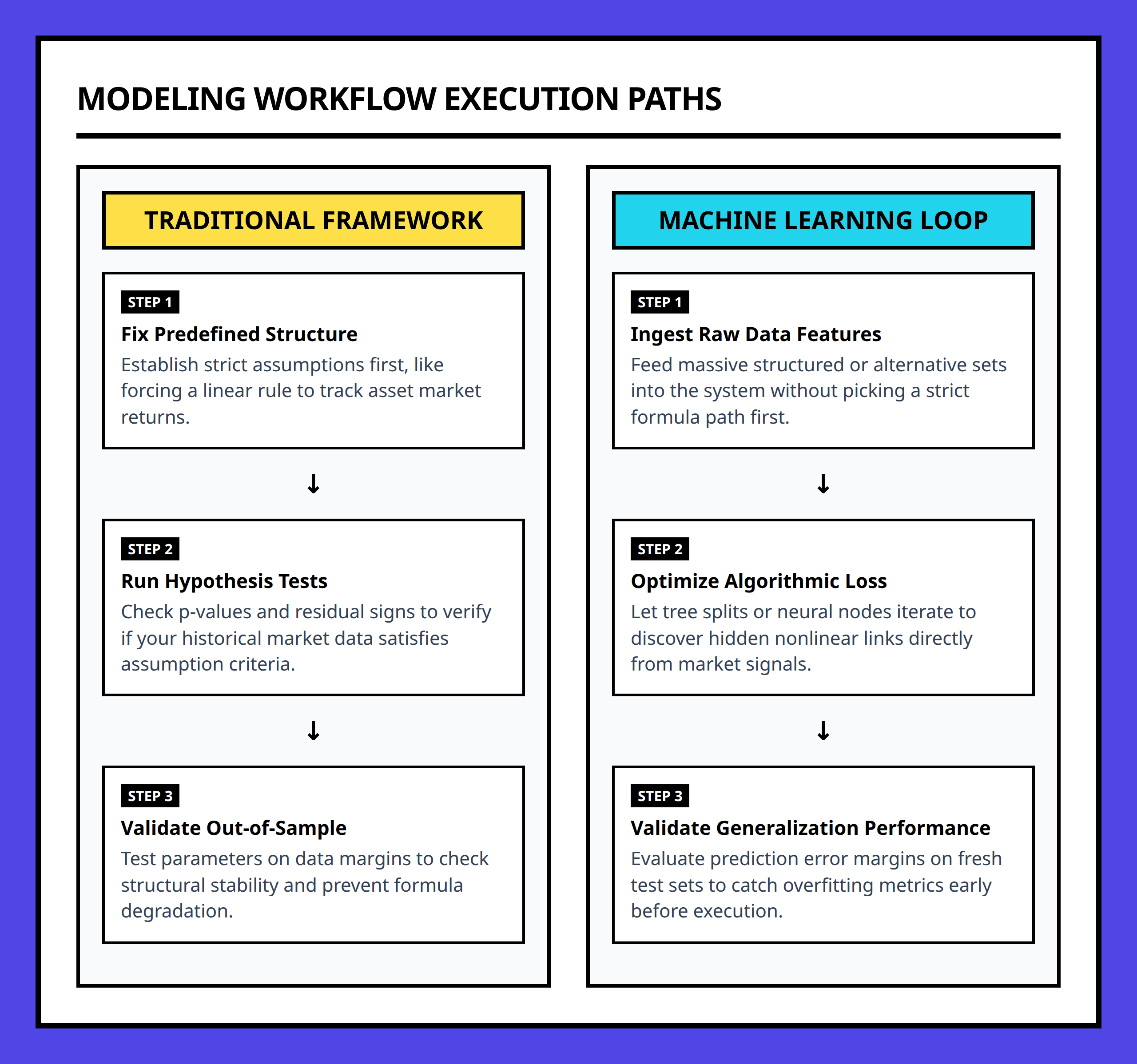
The defining characteristic of traditional financial modeling is that it starts with a theory.
An analyst typically forms a hypothesis about how financial variables should interact and then tests whether the data support that idea. The model itself reflects assumptions made before the analysis begins.
For example, a researcher may believe that certain economic variables influence asset prices in a specific way. A statistical model is then built around that assumption and tested against historical observations.
This approach offers important advantages. The resulting models are often easier to interpret because the relationships are explicitly defined. Analysts can explain why particular variables matter and how they are expected to affect outcomes.
Traditional modeling also provides a structured framework for testing ideas. If the evidence does not support the hypothesis, the model can be revised or rejected.
In many situations, especially when relationships are reasonably well understood, this approach remains highly effective.
The Machine Learning Mindset
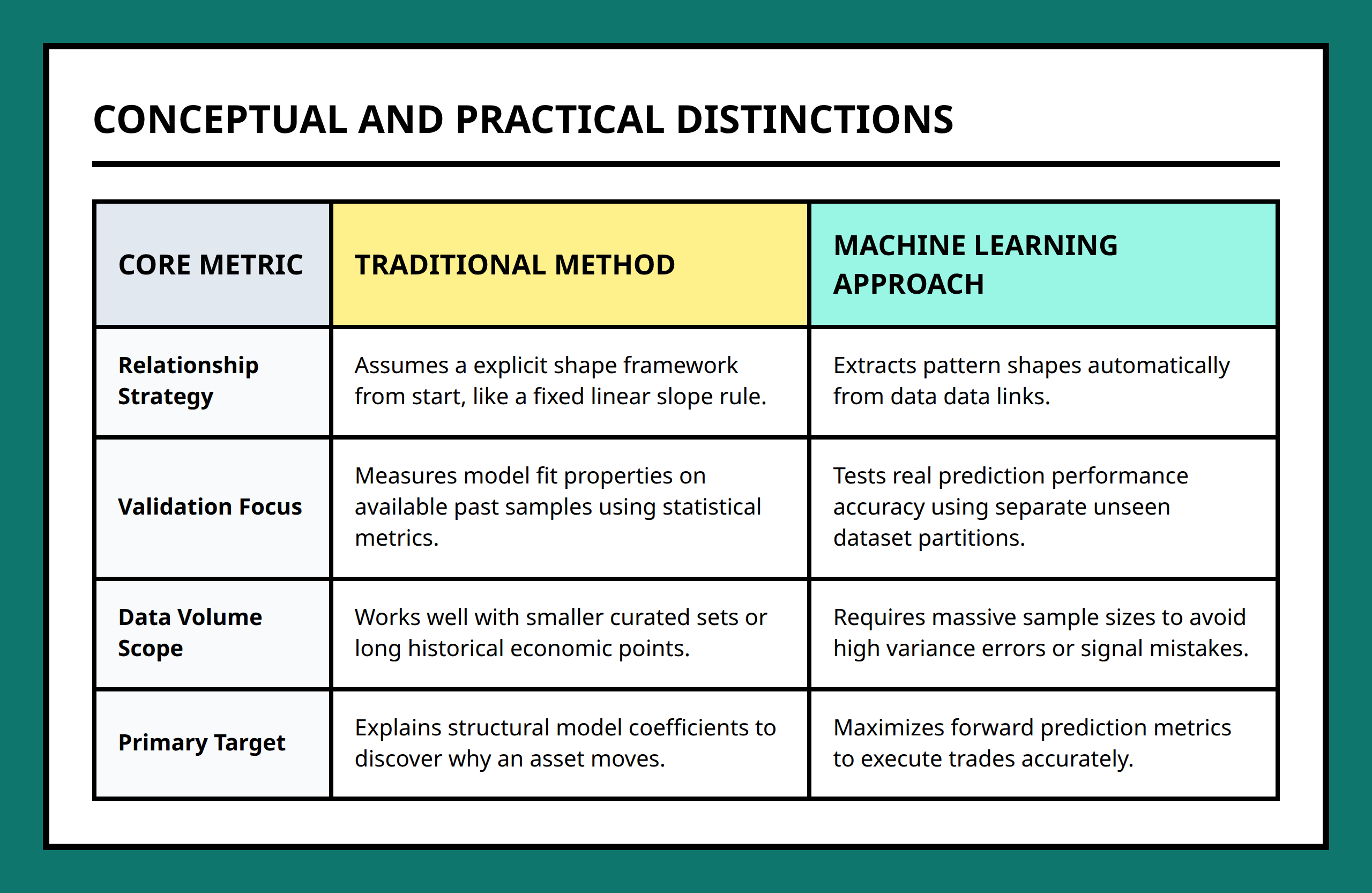
Machine learning begins with a different objective: discover useful relationships rather than assume them.
Instead of specifying a detailed structure beforehand, machine learning algorithms search for patterns within the data itself. The goal is to find a function that connects inputs and outcomes as accurately as possible.
This shift can be subtle but powerful.
Imagine trying to understand a complex system where the true relationships are unknown. Traditional modeling often starts by proposing how the system works. Machine learning starts by asking the data to reveal the structure.
The focus moves away from proving a particular theory and toward generating reliable predictions.
One consequence is that machine learning can sometimes identify relationships that analysts might never have considered. This becomes especially valuable when financial systems contain complicated interactions or nonlinear behavior that are difficult to capture with predefined models.
| Traditional Financial Modeling | Machine Learning |
|---|---|
| Starts with a hypothesis | Starts with data |
| Assumes a model structure | Discovers relationships |
| Focuses on explaining relationships | Focuses on prediction quality |
| Evaluates model fit | Evaluates predictive performance |
| Often simpler to interpret | Can capture more complex patterns |
How Success Is Measured
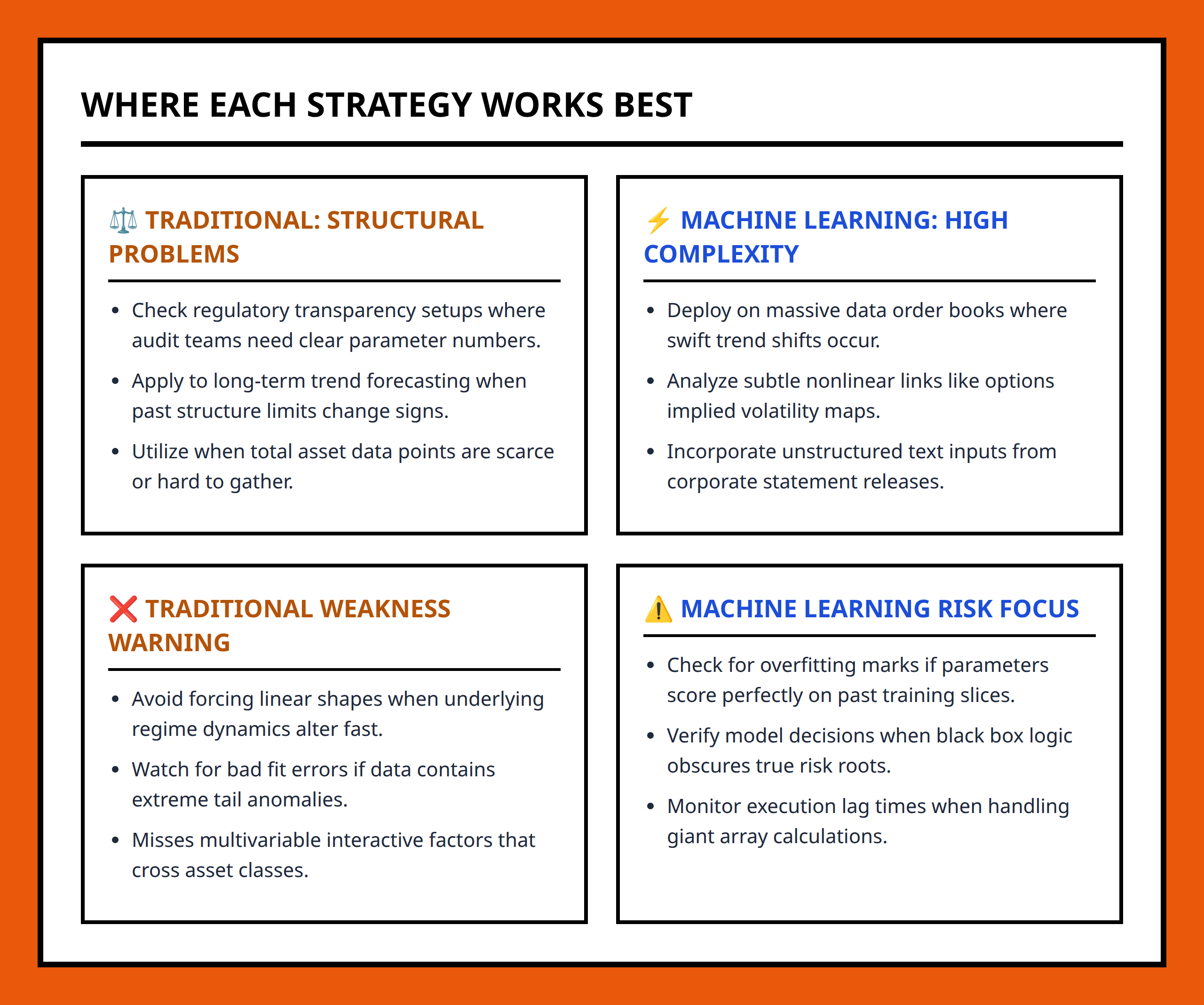
The answer is simple: the two approaches often judge success differently.
Traditional modeling commonly evaluates how well the chosen model fits the observed data and whether its assumptions appear reasonable.
Machine learning places greater emphasis on how accurately a model predicts outcomes using data that were not involved in building the model.
This concept is often called out-of-sample performance.
If a model performs beautifully on historical data but fails when confronted with new observations, its practical value is limited. Machine learning therefore places strong importance on testing models against unseen information.
I find this distinction particularly useful because it highlights the practical purpose of many machine-learning systems: they are often designed first and foremost as prediction tools.
Where Each Approach Works Best
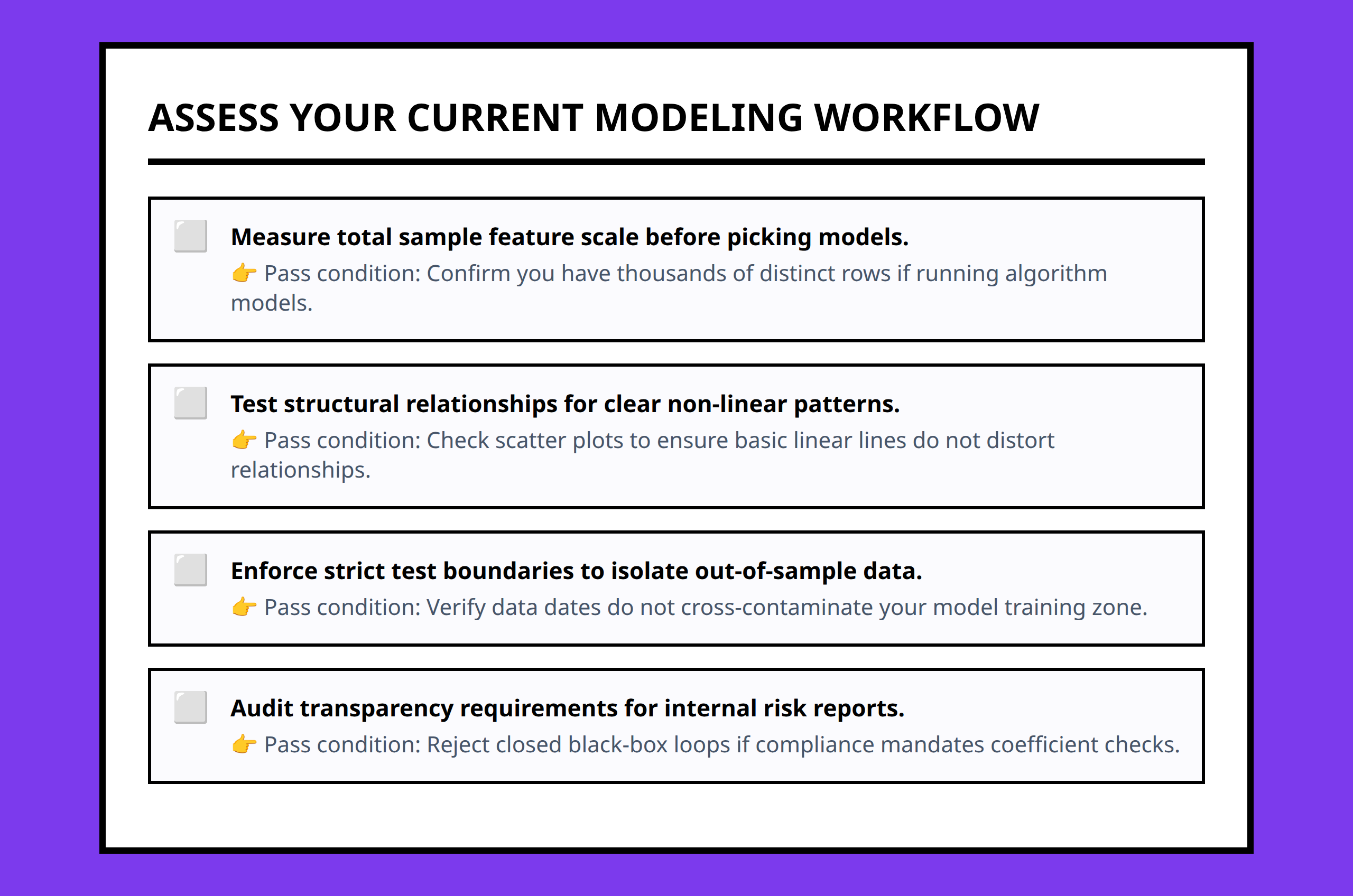
Neither method solves every problem equally well.
Traditional financial modeling is often strongest when analysts possess a clear understanding of the underlying relationships. When theory is well developed and assumptions are reasonable, traditional methods provide clarity, interpretability, and structure.
Machine learning tends to become more attractive when relationships are difficult to specify in advance, when data are large and complex, or when patterns may involve nonlinear interactions.
Consider an illustrative scenario. Suppose an analyst is examining a small set of variables with a clear economic rationale. A traditional approach may be perfectly suitable.
Now imagine a situation involving enormous quantities of market observations, transaction activity, and behavioral information where relationships are less obvious. A machine-learning approach may be better equipped to uncover patterns hidden within that complexity.
The choice should be guided by the problem itself rather than by loyalty to a particular methodology.
The Practical Reality: Most Modern Workflows Use Both
The most useful insight is that modern quantitative finance does not force a choice between the two approaches.
Many successful workflows combine elements of both. Traditional financial reasoning helps define important questions, while machine-learning techniques help identify patterns and improve predictive performance.
This combination recognizes that financial expertise and data-driven discovery can complement one another rather than compete.
The key question is not whether machine learning should replace traditional modeling. The more useful question is whether a particular problem benefits from predefined assumptions, data-driven discovery, or a combination of both.
When evaluating a financial problem, start by asking what is already known about the relationships involved. The answer often reveals whether you should lean more heavily on traditional modeling, machine learning, or a blend of the two.
FAQ
- Machine Learning: A collection of methods that learn patterns from data and use those patterns to make predictions or decisions.
- Financial Modeling: The process of using mathematical or statistical methods to understand and analyze financial relationships.
- Hypothesis: A proposed explanation or relationship that can be tested using data.
- Predictive Analytics: Techniques used to forecast future outcomes based on historical information.
- Out-of-Sample Data: Data that were not used to build a model and are used to evaluate how well the model performs on new information.
- Algorithm: A set of rules or procedures that a computer follows to process information and produce results.
