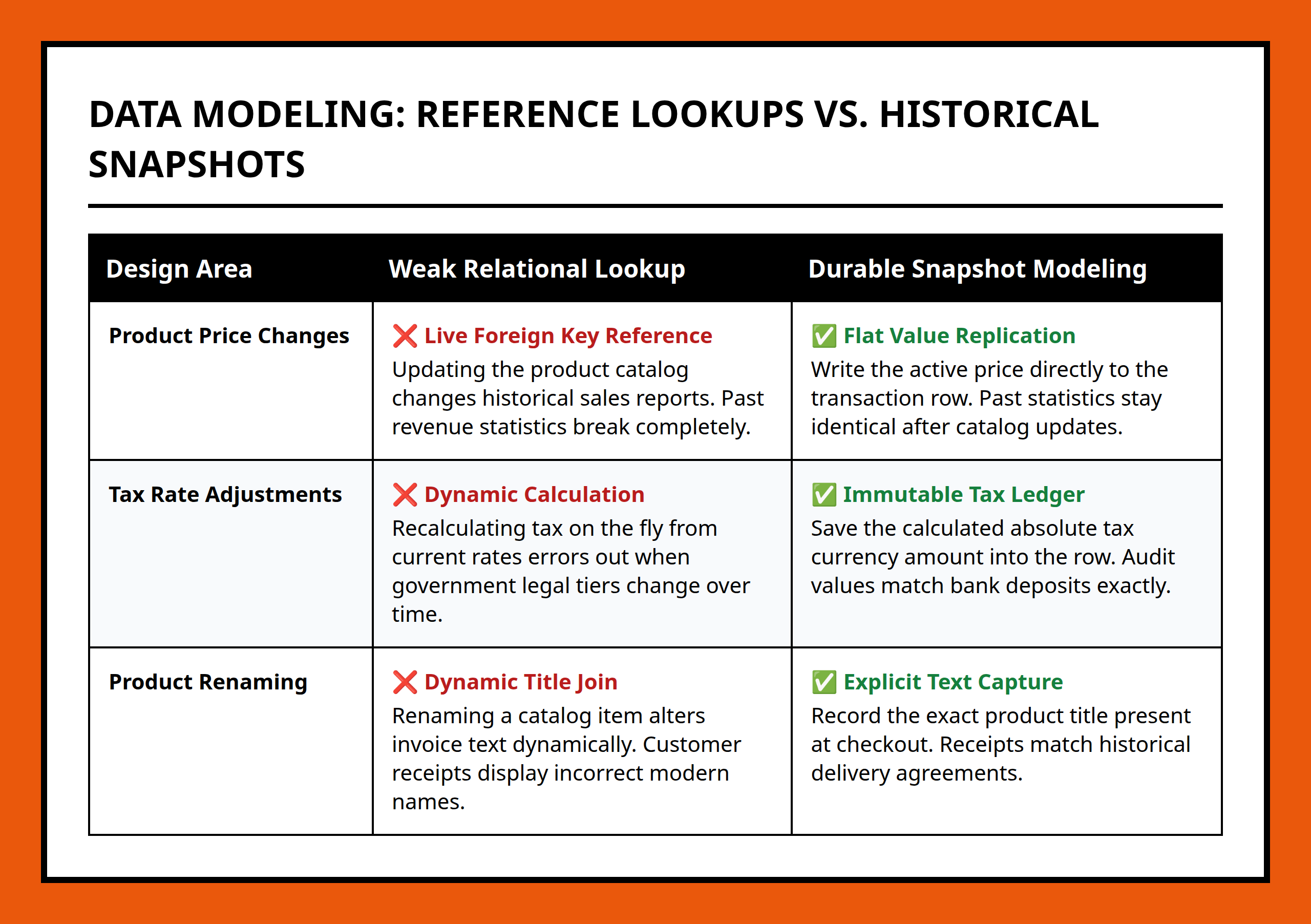
Transaction data modeling becomes far more reliable when each transaction stores a historical snapshot of the information that mattered at the moment the purchase occurred. This approach protects reports, payouts, and financial calculations from future changes to product data.
Many developers assume that storing a product ID is enough. At first, that seems reasonable because the product record already contains the name, price, and other details.
The problem appears later. Products evolve. Prices change. Descriptions are updated. Fees are adjusted. When reports depend on today’s product data to explain yesterday’s transaction, historical accuracy begins to break down.
A transaction should not merely point to history. It should preserve history.
Takeaways
- Store important product information inside the transaction itself.
- Treat transactions as permanent historical records, not temporary calculations.
- Track revenue, fees, taxes, and earnings separately for future reporting.
- Avoid relying exclusively on mutable product records for financial reporting.
- Design transaction records as business evidence that must remain accurate over time.
What Information Every Transaction Record Should Capture

The goal of a transaction record is to preserve what happened at the time of the purchase.
That means the transaction should contain more than a product identifier. It should include the information necessary to understand the transaction long after related records have changed.
Important transaction information often includes:
- Product identifiers
- Product details captured at purchase time
- Purchase amount
- Fees
- Taxes
- Earnings calculations
- Transaction timestamps
When these details are stored within the transaction itself, reporting systems can reconstruct historical activity without depending on the current state of other database records.
Think of a transaction as a permanent receipt. A receipt is valuable because it records what happened at a specific moment, not because it points to information that may change later.
Why Historical Snapshots Matter

Historical snapshots protect the truth of a transaction.
Imagine a product priced one way today and differently six months from now. If reports calculate historical revenue using the current product record, the reported numbers may no longer match what customers actually paid.
A snapshot avoids this problem by storing the relevant product information directly within the transaction when the purchase occurs.
The transaction then becomes a historical record that remains accurate regardless of future product updates.
This approach is especially important for financial reporting because reports often need to answer questions about past events rather than current conditions.
When transaction records preserve their original context, historical reports remain stable and trustworthy even years later.
Tracking Revenue, Fees, Taxes, and Earnings
Reliable financial reporting depends on preserving more than the purchase price.
A transaction may include multiple financial components that contribute to business reporting and payout calculations. Revenue, fees, taxes, and earnings often need to be tracked separately rather than combined into a single amount.
This separation creates greater flexibility for future reporting.
| Financial Component | Reporting Purpose |
|---|---|
| Revenue | Total value generated by the transaction |
| Fees | Costs associated with processing or operations |
| Taxes | Amounts allocated to tax obligations |
| Earnings | Amounts available after applicable deductions |
When each component is preserved within the transaction record, future reports can analyze financial activity without recalculating historical information from changing business rules.
This also simplifies audit scenarios because the transaction contains the information required to explain how a particular amount was derived.
Common Data Modeling Errors
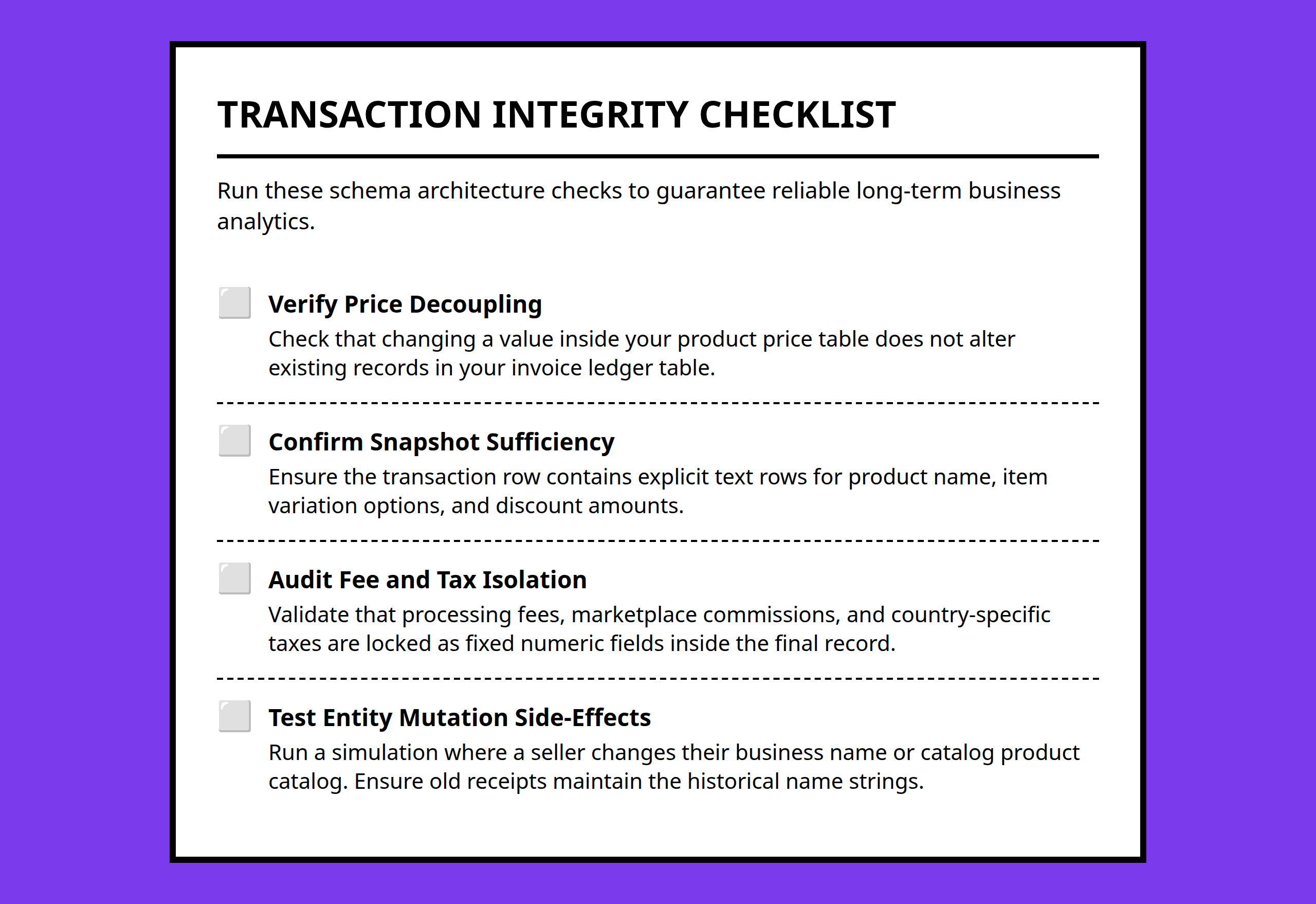
The most common mistake is treating transactions as references rather than records.
When a transaction stores only links to products and relies on those products for historical details, reporting becomes vulnerable to future changes.
Another mistake is storing only final totals while ignoring the underlying components that produced those totals. This can make financial analysis and troubleshooting significantly more difficult later.
A third mistake is assuming that today’s business rules will always match tomorrow’s business rules. Historical transaction records should preserve the calculations and context that existed when the transaction occurred.
I find that durable transaction systems are usually built around one principle: preserve information at the moment it becomes historically important.
Permanent Records Create Long-Term Trust

The best transaction architectures are designed with the future in mind. Years after a purchase occurs, the system should still be able to explain exactly what happened and why.
That is why historical snapshots matter so much. They allow reports, audits, payouts, and financial analysis to rely on preserved facts rather than reconstructed assumptions.
A practical next step is to review your transaction tables and ask a simple question: if the related product disappeared or changed tomorrow, would the transaction still tell the complete story?
FAQ

- Transaction Record: A permanent record of a completed financial event such as a purchase or payment.
- Historical Snapshot: A copy of important information stored at the time an event occurs so it remains available even if related records change later.
- Transaction Data Modeling: The process of designing database structures that store and organize transaction information.
- Revenue: The value generated by a transaction before other financial adjustments are applied.
- Financial Audit Trail: A historical record that allows financial activity to be reviewed, verified, and explained.
- Earnings: The amount associated with a transaction after applicable fees, taxes, or deductions have been accounted for.
