Big Data Finance is not simply about collecting huge amounts of information. It is about using data science, machine learning, and advanced analytics to uncover signals that help investors, analysts, and financial institutions make better decisions in increasingly complex markets.
Many people hear the phrase Big Data Finance and immediately think of giant databases, expensive technology, or highly technical trading systems. I think that view misses the most important point. The real value comes from finding useful meaning inside an overwhelming amount of information.
What makes this topic especially important is that modern markets generate far more information than traditional financial methods were designed to handle. New forms of data appear constantly, and organizations that can interpret them effectively often gain an advantage in forecasting, risk management, and investment decisions.
This shift is changing how financial professionals think about research, analysis, and even the nature of competitive advantage itself.
Takeaways
- Big Data Finance is about extracting meaningful signals from data, not merely collecting large datasets.
- Modern financial information includes both traditional market data and alternative data sources.
- Machine learning focuses on discovering patterns and predictive relationships rather than relying entirely on predefined assumptions.
- The growing volume of financial data is creating demand for professionals who can combine finance knowledge with data science skills.
Why Finance Entered the Big Data Era
The short answer is simple: the amount of available information exploded.
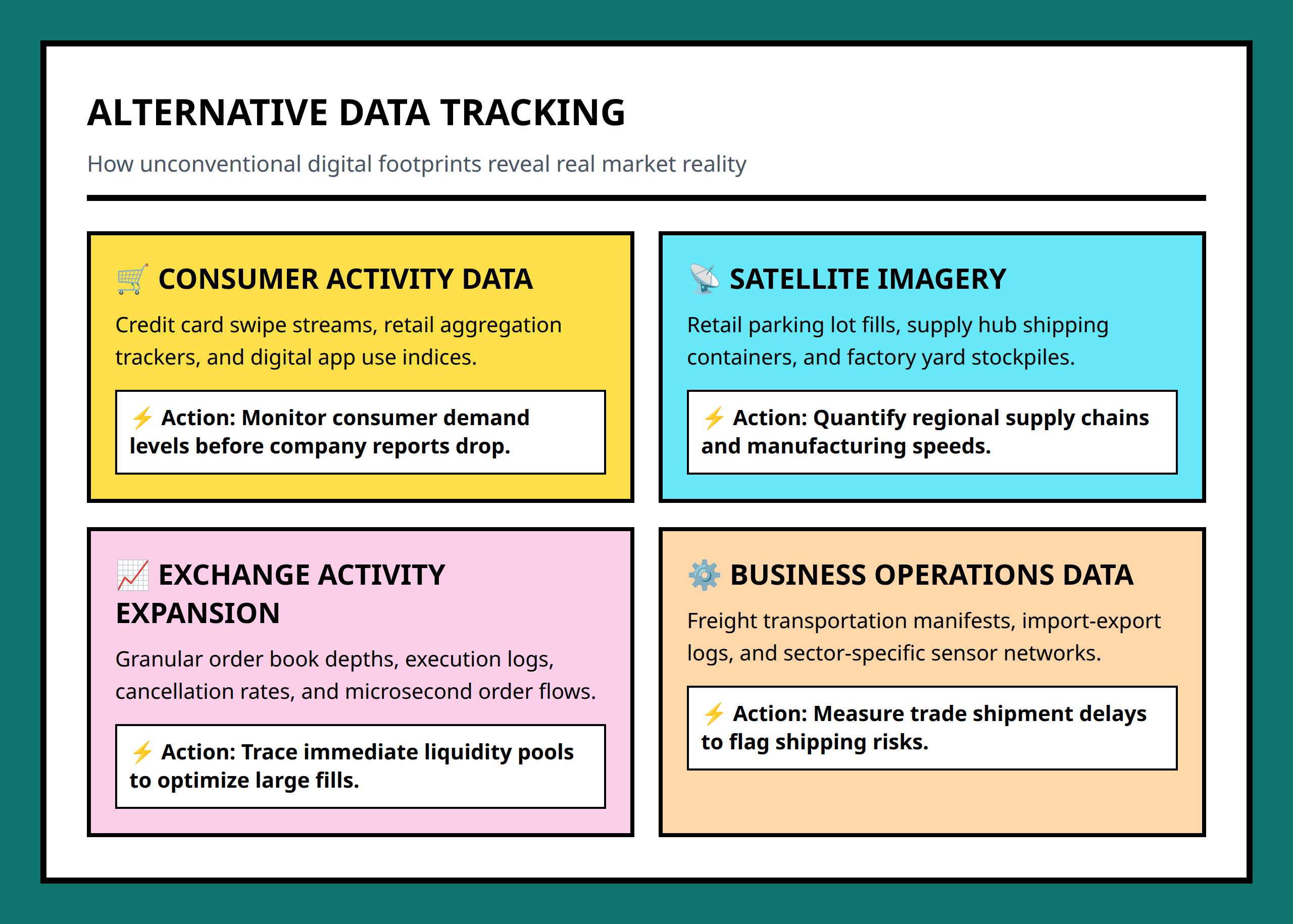
Financial institutions no longer operate in a world where daily prices and trading volumes are the primary sources of information. Today, data are generated by consumer activity, digital transactions, business operations, communication systems, and financial markets themselves.
Consider a simple example. Consumer purchases can reveal changes in demand patterns before those changes appear in earnings reports or economic statistics. Data from shopping behavior, payment systems, and commercial activity may contain clues about future market developments.
Business activity has become another valuable source of information. Supply-chain activity, ordering patterns, and operational behavior can all create signals that help analysts better understand economic trends.
Financial markets generate enormous quantities of information as well. Modern exchanges record individual events in remarkable detail, including order arrivals, cancellations, updates, and other market activities. Instead of receiving only summary data, analysts now have access to highly granular streams of market information.
The result is a world where potentially useful information exists almost everywhere. The challenge is no longer obtaining data. The challenge is identifying which data matter and extracting useful insights from them.
What Makes Big Data Finance Different?
Many discussions focus on the size of datasets. That is understandable, but it can also be misleading.
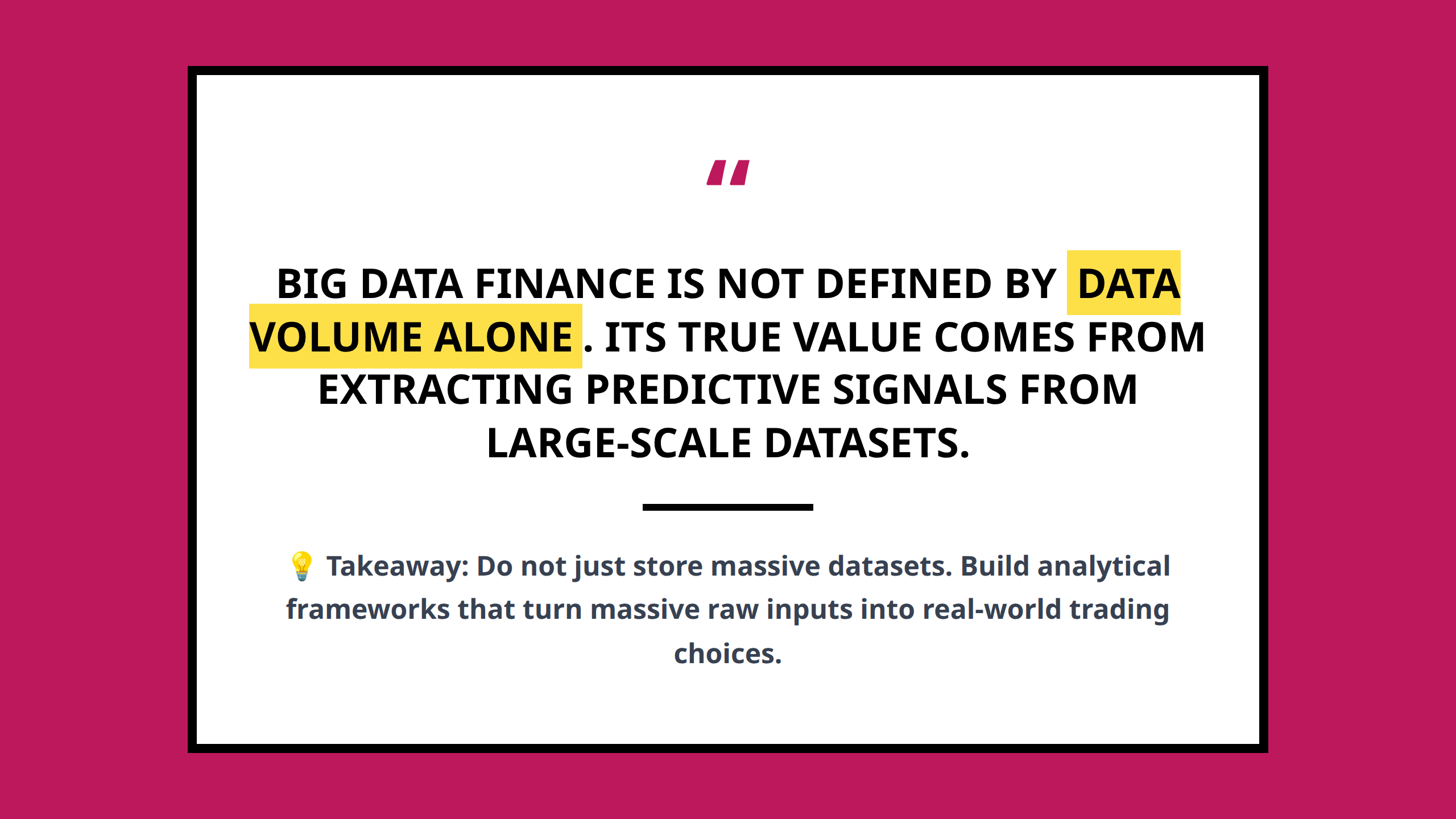
Big Data Finance is defined more by its analytical approach than by data volume alone.
The goal is not simply to store information. The goal is to discover meaningful relationships that help explain, predict, or understand financial outcomes.
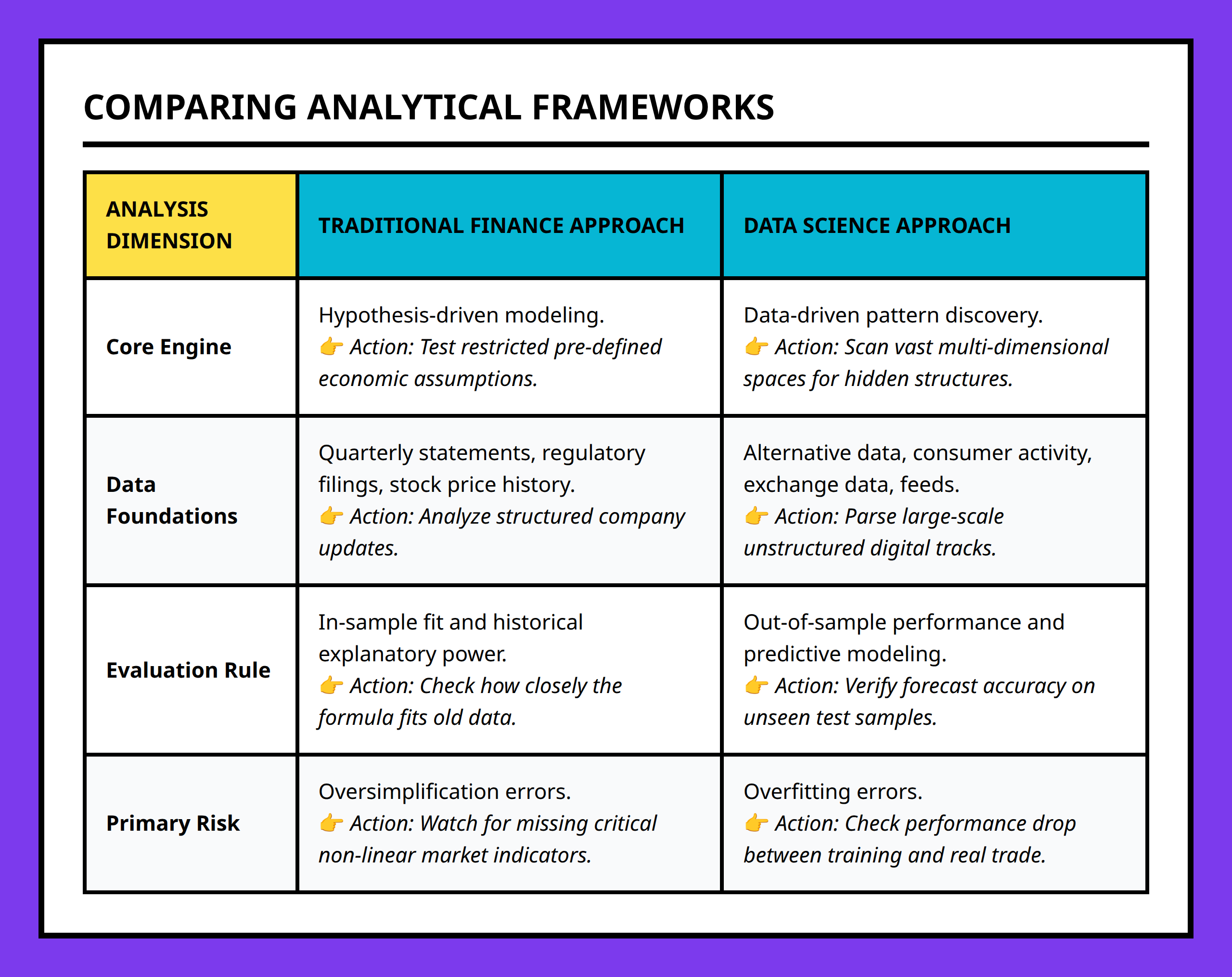
Traditional financial analysis often starts with a specific hypothesis. An analyst develops a theory and then tests whether available data support it.
Big Data approaches frequently begin from a different direction. Instead of asking whether a particular theory is correct, they allow algorithms to search for patterns, relationships, and structures that may not be obvious to human researchers.
This distinction becomes important when dealing with highly complex systems where many variables interact simultaneously.
| Traditional Modeling | Data Science Approach |
|---|---|
| Starts with a predefined hypothesis | Searches for relationships directly in the data |
| Assumes a specific model structure | Allows algorithms to discover patterns |
| Focuses heavily on model assumptions | Focuses heavily on predictive performance |
| Often evaluates goodness of fit | Often evaluates out-of-sample prediction accuracy |
Neither approach is automatically superior. In practice, many successful organizations combine both.
How Machine Learning Changes Financial Analysis

Machine learning introduces a different way of thinking about financial data.
Instead of assuming that relationships between inputs and outcomes follow a predefined structure, machine learning attempts to learn those relationships from observed data.
This approach is particularly useful when financial systems contain nonlinear behavior, hidden interactions, or patterns that are difficult to describe with traditional formulas.
One useful way to think about machine learning is to imagine a black box. Inputs enter one side, outcomes emerge from the other, and the challenge is understanding the connection between them.
Traditional modeling often begins by defining what that connection should look like. Machine learning focuses on finding a predictive function that best captures the relationship, even when the underlying structure is unknown.
The emphasis shifts from explaining every detail of the process to improving predictive accuracy and discovering useful patterns.
Major Applications of Big Data Finance
Big Data Finance influences many areas of modern financial decision-making.
Portfolio Management
Investment professionals increasingly use data-driven techniques to identify opportunities, evaluate risk, and generate new sources of insight.
Instead of relying exclusively on traditional financial indicators, analysts can incorporate broader information sources that may reveal developing trends earlier.
Risk Analysis
Large datasets allow organizations to monitor complex systems in greater detail. This can improve the ability to identify emerging risks, changing market conditions, and unusual patterns of behavior.
Signal Generation
One of the most valuable applications involves transforming raw information into actionable investment signals.
For example, analysts may examine large collections of data and search for relationships that consistently precede changes in market behavior. The resulting signals can become inputs for investment decisions.
Market Forecasting
Forecasting remains one of the most challenging tasks in finance. Big Data techniques do not eliminate uncertainty, but they can improve the ability to identify patterns that may have predictive value.
The focus is often on improving forecasts through better information rather than relying solely on traditional indicators.
The Growing Demand for Data-Driven Financial Skills
The expansion of Big Data Finance is changing the types of expertise financial organizations need.
Modern institutions increasingly require professionals who can acquire, manage, analyze, and interpret large datasets.
Some roles focus on discovering new sources of information. Others focus on building models that transform data into practical insights. Specialized experts may also be needed to understand the meaning behind particular datasets and connect those insights to financial decisions.
This trend highlights an important reality: technology does not simply replace work. It often changes the nature of the work being done.
As financial systems become more data-intensive, the ability to combine domain expertise with analytical skills becomes increasingly valuable.
FAQ
Why This Matters Going Forward
The most important lesson is that the future of finance is increasingly tied to the ability to interpret information effectively.
Markets continue to generate more data, not less. Organizations that can transform that information into meaningful signals are often better positioned to understand opportunities, risks, and changing conditions.
If you want to prepare for that future, a practical next step is to strengthen both sides of the equation: deepen your understanding of finance while developing a working knowledge of data science and machine learning. The combination is becoming far more valuable than either skill set alone.
- Big Data Finance: The use of advanced analytical methods to extract meaningful insights from large and complex financial and non-financial datasets.
- Machine Learning: A set of techniques that allow algorithms to learn patterns from data and make predictions without relying entirely on predefined rules.
- Alternative Data: Information outside traditional financial statements and market prices that may provide useful investment insights.
- Predictive Modeling: Building analytical models designed to forecast future outcomes based on historical data.
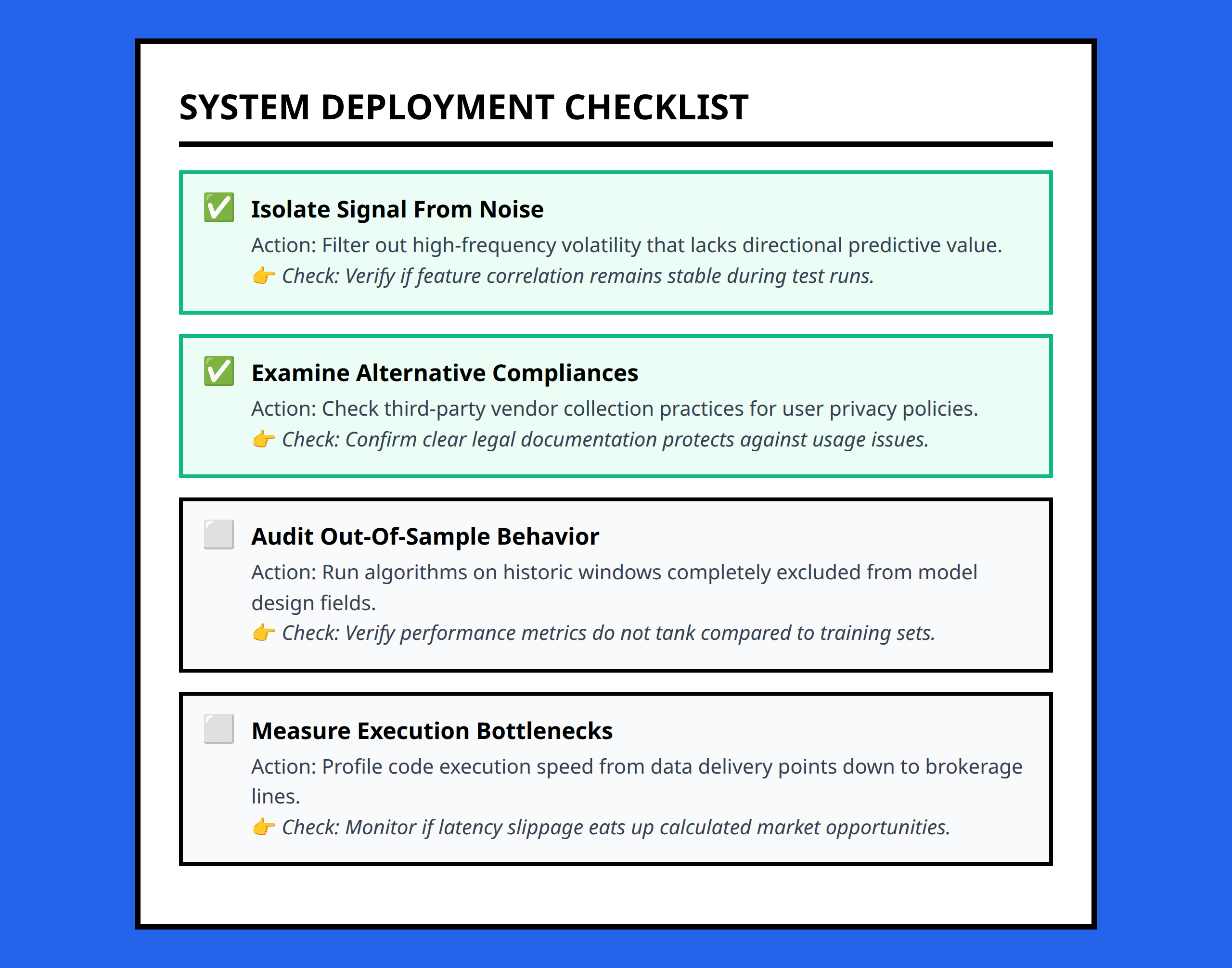
- Out-of-Sample Testing: Evaluating a model using data that were not used during model development to assess predictive performance.
- Investment Signal: A piece of information or analytical output used to support investment decisions.
