DeFi infrastructure is not built on blockchain alone. It depends on blockchain networks, smart contracts, oracles, stablecoins, and decentralized applications working together to create a programmable financial system.
Many people can describe what DeFi does but struggle to explain how it actually works. Terms like blockchain, smart contracts, stablecoins, and oracles often appear in the same conversation without a clear explanation of how they connect.
I find that most confusion disappears when you stop viewing these technologies as separate concepts and start viewing them as layers of a single system. Each component solves a different problem, and none of them is particularly useful in isolation.
Understanding these layers makes it much easier to evaluate DeFi applications, lending platforms, exchanges, and other blockchain-based financial services.
Takeaways
- Blockchain provides the shared ledger that records financial activity.
- Smart contracts automate financial rules and transactions.
- Oracles connect blockchain systems to information outside the blockchain.
- Stablecoins help reduce the challenges created by cryptocurrency price volatility.
- Decentralized applications combine these components into usable financial services.
Blockchain as the Shared Financial Ledger
The foundation of DeFi is the blockchain.
A blockchain serves as a shared ledger that records transactions across a network of participants. Instead of relying on a central organization to maintain records, the network collectively verifies and stores information.
This shared ledger creates a common source of truth for financial activity. Transactions, balances, and asset transfers can be recorded in a way that participants can independently verify.
Two important concepts often appear when discussing blockchain infrastructure: proof-of-work and proof-of-stake.
These are mechanisms used by blockchain networks to validate activity and maintain agreement across participants. While the technical details vary, both approaches aim to ensure that transaction records remain consistent and trustworthy.
Without this foundational ledger, the rest of the DeFi ecosystem would have no common platform on which to operate.
Why Smart Contracts Enable Programmable Finance
The direct answer is simple: smart contracts transform a blockchain from a record-keeping system into a financial operating system.
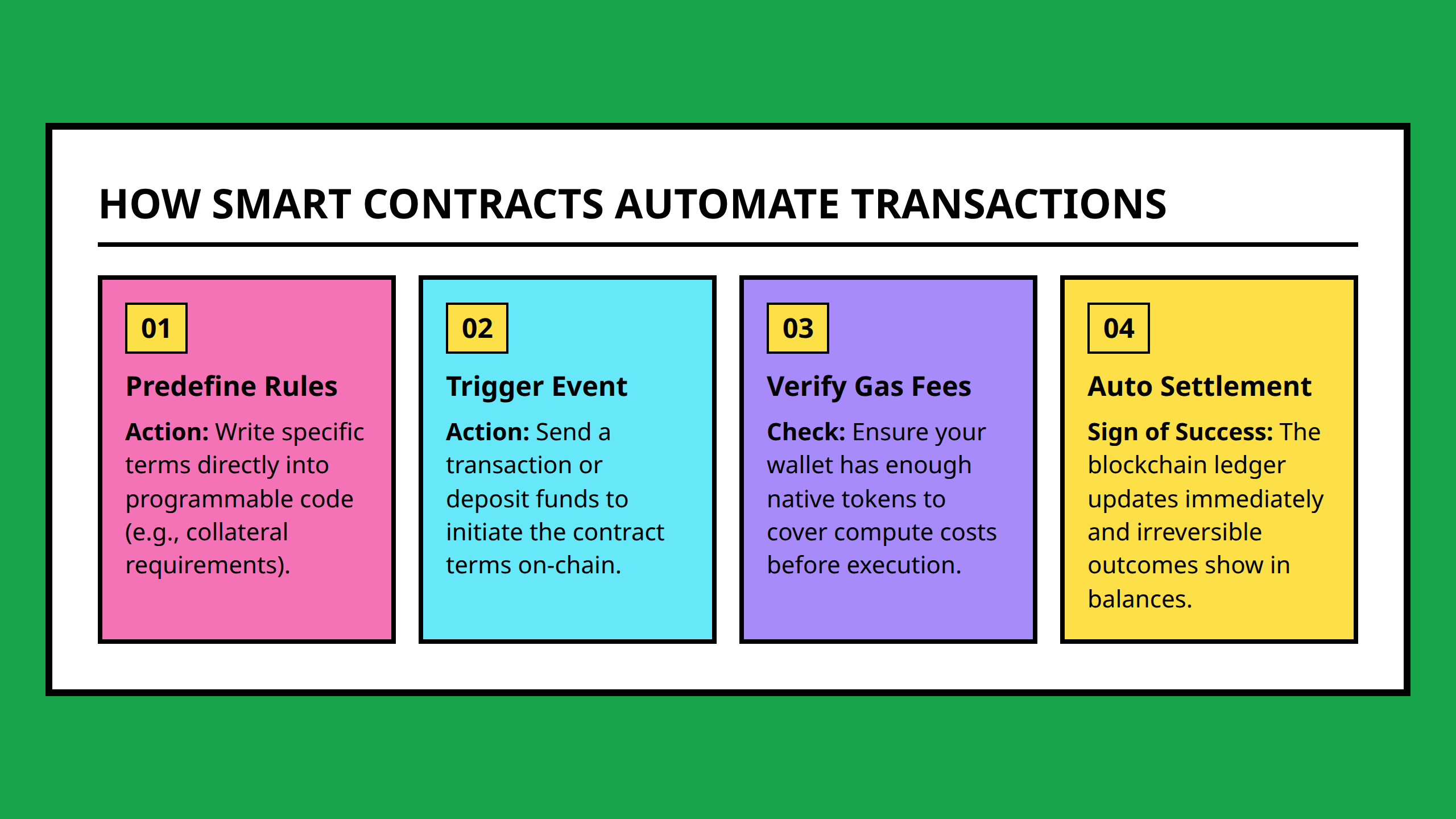
Smart contracts are pieces of software that automatically execute predefined rules. They can hold digital assets, process transactions, and enforce conditions without requiring a traditional intermediary to oversee every step.
Imagine a lending arrangement where collateral must remain above a specific threshold. Instead of relying on manual oversight, a smart contract can automatically apply the agreed rules.
This ability to automate financial logic is one of the most important innovations within DeFi.
Smart contracts also introduce the concept of gas fees. Because blockchain networks require computing resources to process transactions and execute code, users typically pay fees for those operations.
These fees help support network activity while ensuring that resources are allocated efficiently.
When people describe DeFi as programmable finance, smart contracts are usually the reason.
The Oracle Problem and External Data
One challenge often surprises newcomers: blockchains generally do not know what is happening outside their own networks.
A blockchain can verify transactions occurring on-chain, but many financial applications require information from the outside world. Asset prices, exchange rates, and other market information may be essential for a protocol to function properly.
This is where oracles become important.
Oracles act as bridges between blockchain systems and external information sources. They deliver data that smart contracts need in order to perform certain tasks.
Consider a lending application that uses digital assets as collateral. The system may need current pricing information to determine whether collateral remains sufficient. Without an oracle, the smart contract would lack the information needed to make that determination.
This creates what many refer to as the oracle problem. The blockchain itself may be secure, but the quality and reliability of external information become critical.
As a result, oracle infrastructure plays an important role in the overall trustworthiness of DeFi systems.
Stablecoins Solve a Practical Problem

One of the biggest obstacles to using cryptocurrencies in financial applications is price volatility.
Large price movements can create challenges for lending, borrowing, payments, and asset management. A financial system requires some degree of stability if users are expected to rely on it for everyday activity.
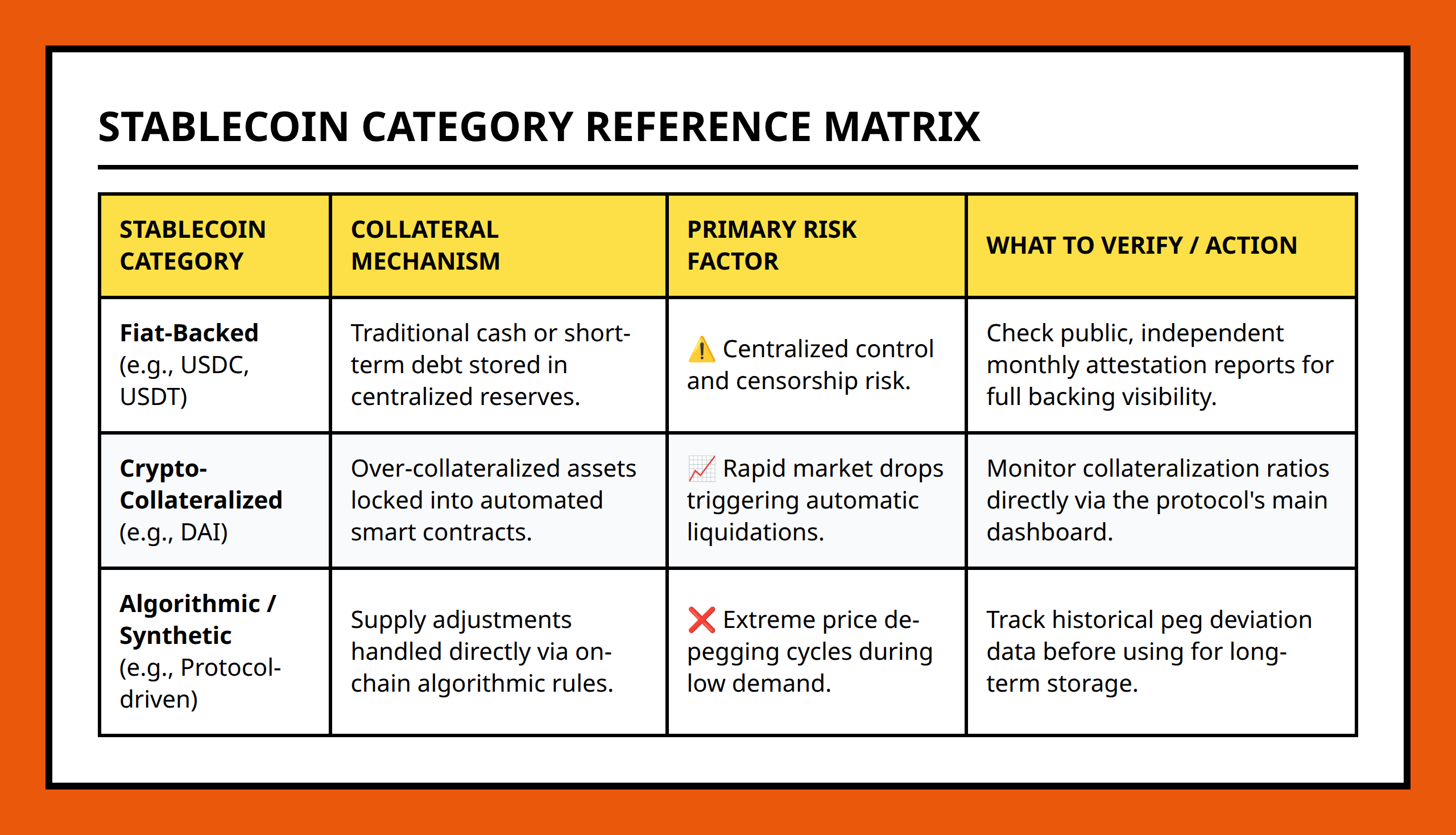
Stablecoins attempt to address this issue by maintaining a relatively stable value.
Different stablecoin designs exist, but their shared objective is to provide a digital asset that behaves more predictably than many traditional cryptocurrencies.
This stability makes stablecoins useful as settlement assets, trading pairs, and units of account within DeFi ecosystems.
For many users, stablecoins serve as a practical bridge between blockchain-based finance and everyday economic activity.
How Decentralized Applications Bring Everything Together

The final layer is the decentralized application, often called a dApp.
A dApp is the user-facing application that allows people to interact with blockchain-based financial services.
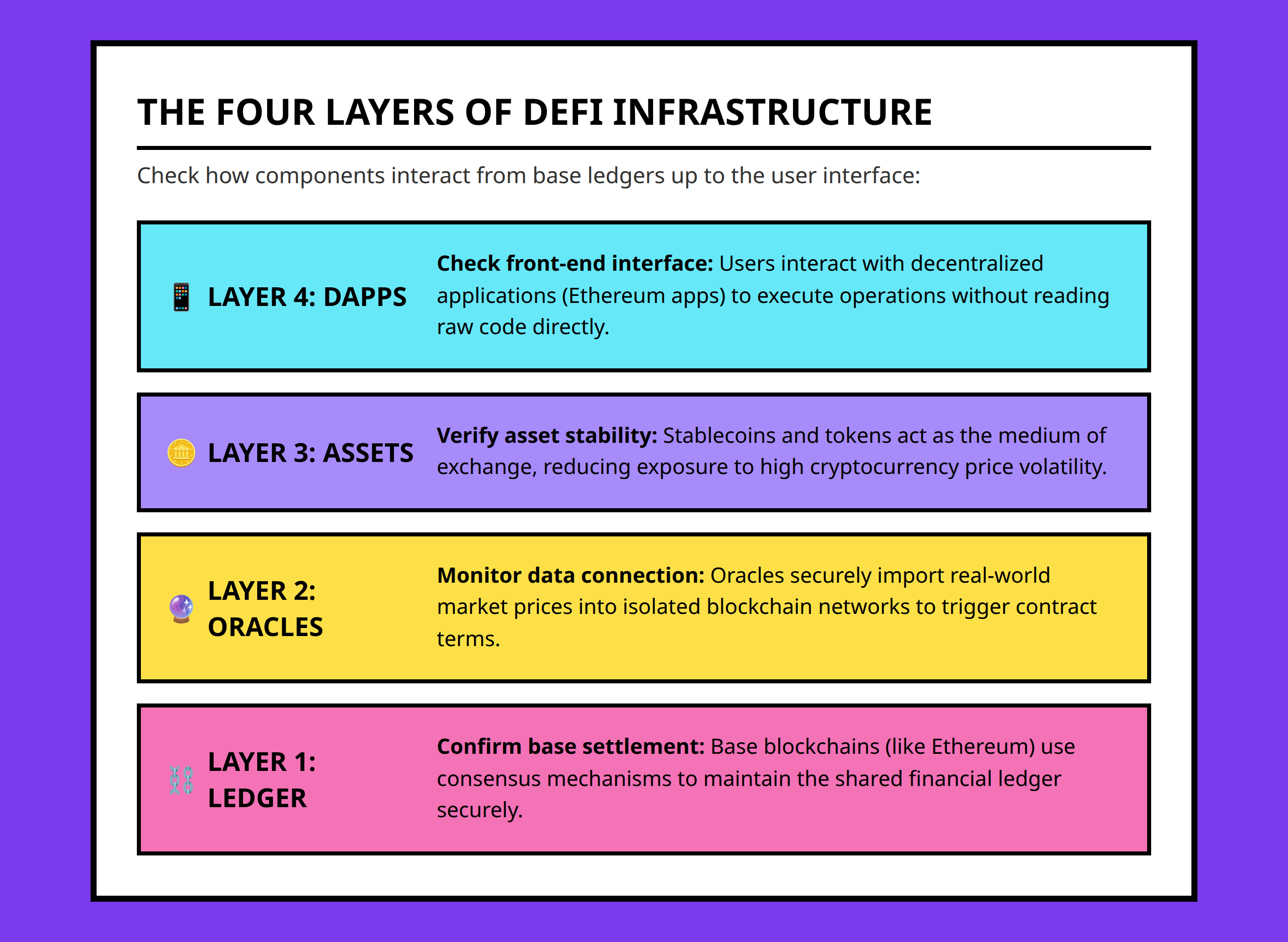
When someone uses a lending platform, exchanges assets, or manages digital holdings through a DeFi service, the visible interface is often a dApp. Behind the scenes, that application may interact with smart contracts, stablecoins, oracle networks, and the underlying blockchain.
This layered structure helps explain why DeFi should be viewed as an ecosystem rather than a single technology.
| Infrastructure Layer | Main Function |
|---|---|
| Blockchain | Records and verifies transactions |
| Smart Contracts | Execute financial rules automatically |
| Oracles | Provide external information |
| Stablecoins | Provide a more stable digital asset |
| dApps | Deliver user-facing financial services |
Each layer depends on the others. Remove one component and the overall system becomes less capable or, in some cases, unusable.
FAQ

- Blockchain: A distributed ledger that records transactions across a network of participants.
- Smart Contract: Software that automatically executes predefined rules on a blockchain.
- Proof-of-Work: A blockchain validation mechanism that uses computational effort to secure the network.
- Proof-of-Stake: A blockchain validation mechanism that relies on participant stake rather than computational work.
- Oracle: A system that supplies external information to blockchain applications.
- Stablecoin: A digital asset designed to maintain a relatively stable value.
- dApp: A decentralized application that operates using blockchain infrastructure and smart contracts.
- Gas Fee: A fee paid to execute transactions or smart contract operations on a blockchain network.
When evaluating any DeFi protocol, it helps to ask a simple question: which infrastructure layers does it depend on? Looking beyond the user interface and understanding the blockchain, smart contracts, oracles, and stablecoins underneath often reveals far more about how the system actually works than the application itself.
