Corporate finance is not just about raising money or calculating returns. It is a system for making decisions that help a business create value over time. Understanding how financial analysis, investment decisions, financing choices, and governance fit together makes finance far easier to understand—and far more useful in practice.
One reason many people struggle with finance is that they learn it in pieces. They learn accounting ratios in one place, valuation methods in another, and capital structure somewhere else. The result is a collection of tools without a clear picture of how they connect.
I find it more useful to think of corporate finance as a single decision-making framework. Every major financial choice ultimately comes back to one question: does this decision increase the value of the business over the long term?
Takeaways
- Financial analysis is the starting point because you cannot make good decisions without understanding a company’s economic and financial situation.
- Investment decisions, financing decisions, and risk management are interconnected rather than separate activities.
- Value creation provides the common objective that ties together most corporate finance decisions.
- Governance and financial policies influence how value is created and shared among stakeholders.
What Corporate Finance Actually Covers
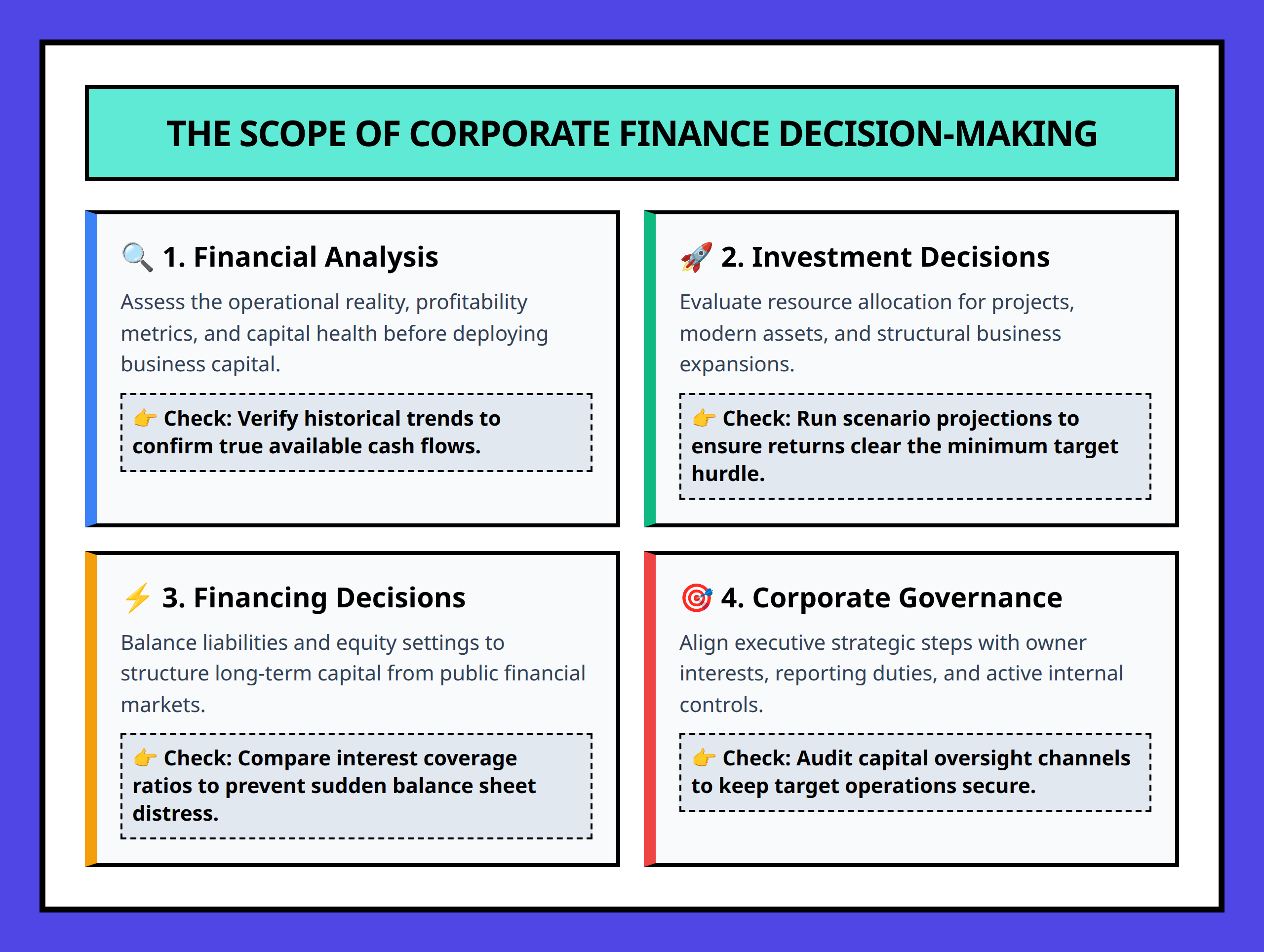
At its core, corporate finance focuses on how businesses create value and how financial decisions support that goal. Rather than being limited to funding or accounting, it covers a broad range of activities that influence the future of a company.
The foundation is financial analysis. Before managers can decide where to invest, how much debt to use, or whether to return cash to shareholders, they need a clear understanding of the business itself. That means examining earnings, cash flows, investments, financing sources, profitability, and solvency.
Financial markets also play an important role. Businesses do not operate in isolation. They interact with investors, banks, and capital markets through financial securities such as shares, bonds, and other financing instruments. These relationships influence how companies raise capital and how investors evaluate value.
Consider a simple illustrative scenario. A company may have an opportunity to expand production. Before moving forward, management must understand current profitability, assess future cash flows, determine financing options, evaluate risk, and estimate whether the expansion will increase value. Corporate finance provides the framework for answering all of those questions.
The Value Creation Framework
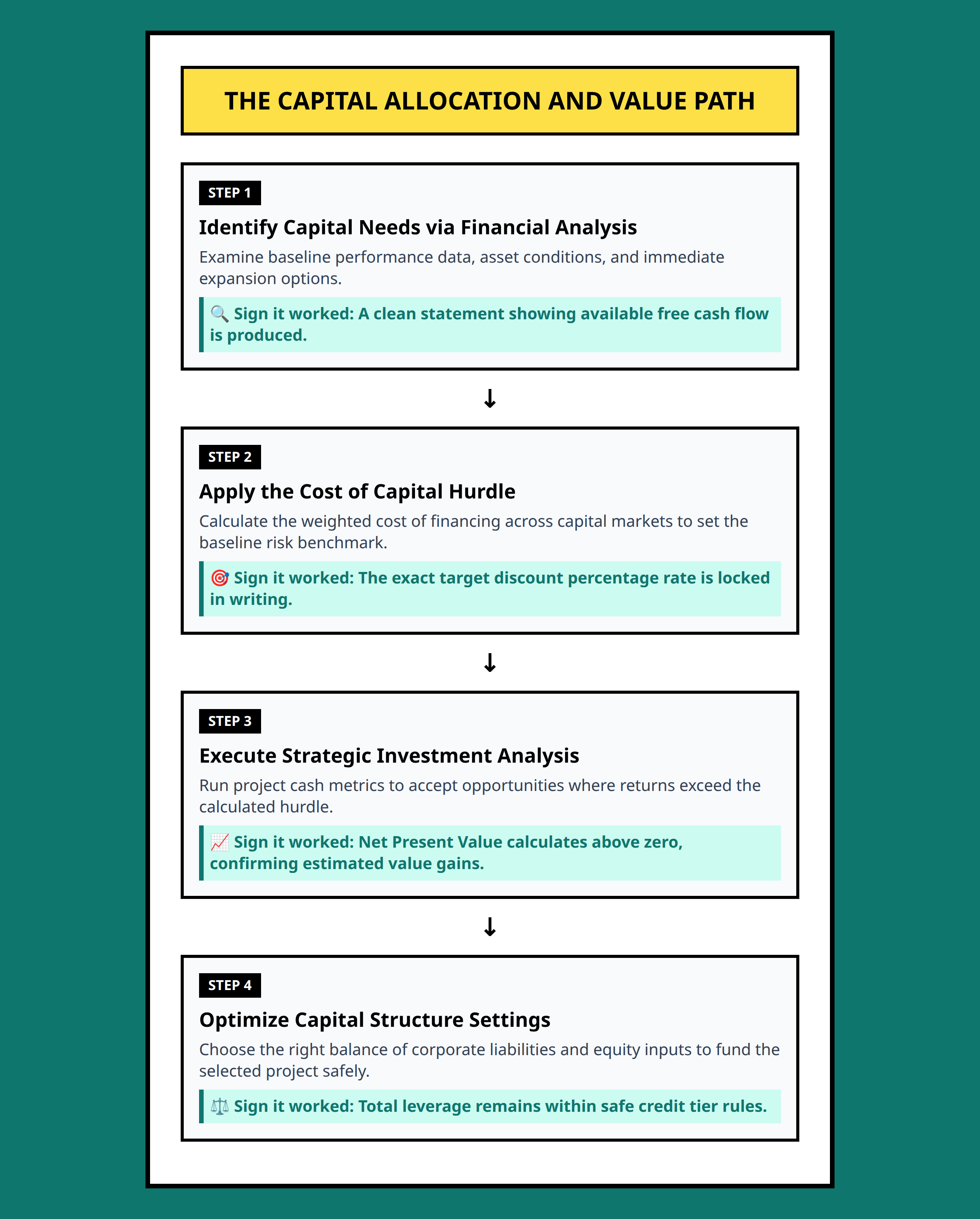
The most useful way to understand corporate finance is to see value creation as the central objective.
Businesses create value by generating wealth through operations, investing that wealth effectively, financing investments responsibly, and earning returns that justify the risks being taken. These activities form a connected chain rather than separate decisions.
| Area | Primary Question |
|---|---|
| Financial Analysis | Where does the company stand today? |
| Investment Decisions | Which projects should receive capital? |
| Financing Decisions | How should investments be funded? |
| Risk Assessment | Are expected returns adequate for the risks involved? |
| Valuation | Does the decision increase value? |
Investment decisions determine where capital is allocated. Every project competes for limited resources. The challenge is not simply choosing profitable projects but choosing projects that create the most value relative to their risks.
Financing decisions determine how those investments are funded. A company may rely on equity, debt, internally generated cash flows, or a combination of these sources. The financing choice affects risk, flexibility, and the cost of capital.
Risk and return cannot be separated from these decisions. A project that appears attractive may become less appealing once uncertainty is considered. Likewise, a safer project may generate lower returns but still create more value when adjusted for risk.
An illustrative example is a company evaluating a new production facility. Management must estimate future cash flows, determine investment costs, choose a financing structure, assess risks, and evaluate whether the expected value exceeds the resources committed. Each step influences the others.
Financial Policies That Shape Long-Term Outcomes
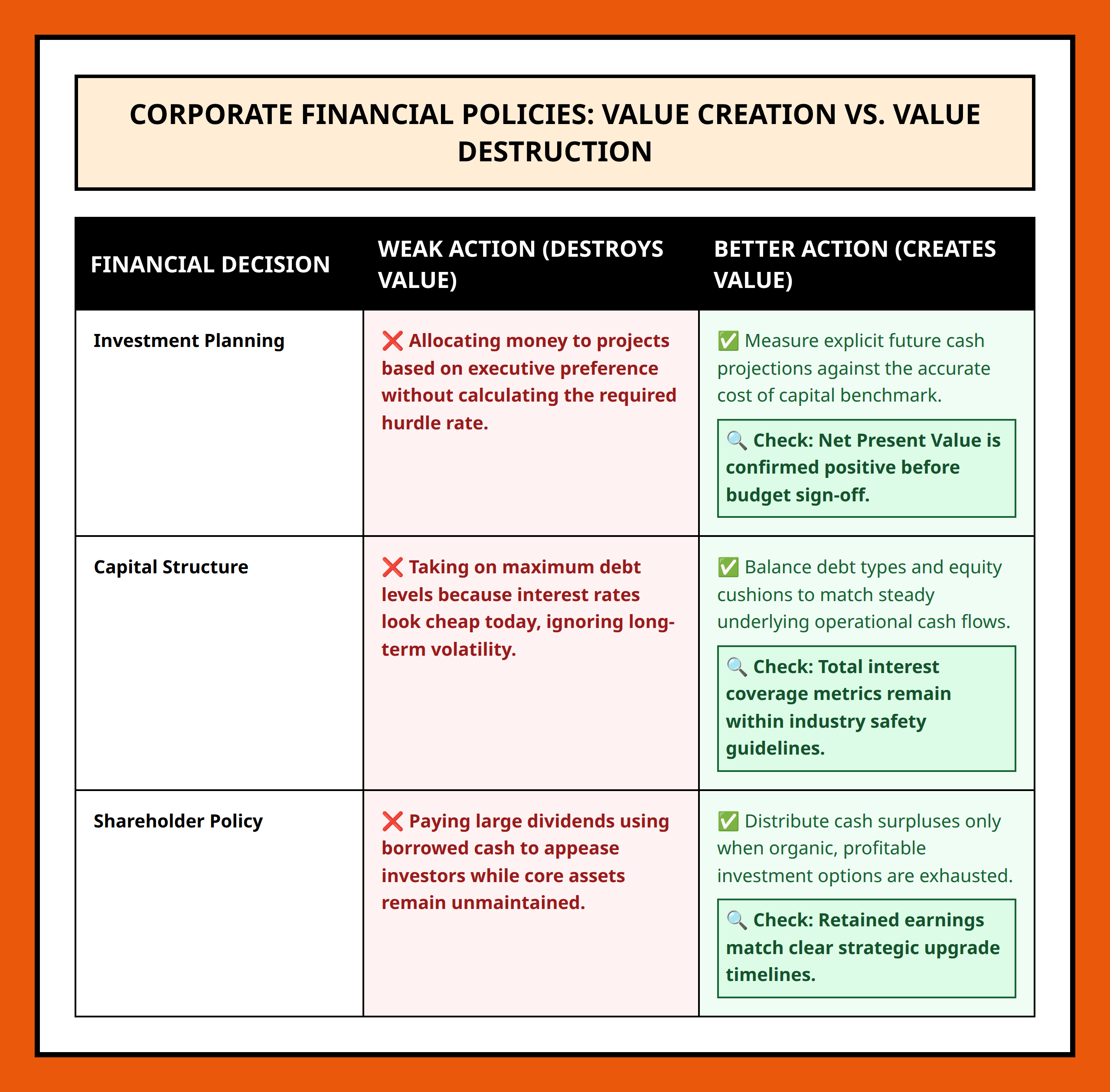
Individual decisions matter, but long-term results are heavily influenced by a company’s financial policies.
Capital structure policy determines the balance between debt and equity financing. This affects financial flexibility, risk exposure, and relationships with investors and lenders. Too much debt can increase vulnerability during difficult periods. Too little debt may limit opportunities or reduce financial efficiency.
Shareholder distribution policies influence how value is shared. Companies must decide whether to reinvest cash into growth opportunities or return cash through dividends, share buybacks, or other mechanisms. The right choice depends on available opportunities for future value creation.
Governance influences how decisions are made and whose interests are prioritized. Good governance helps align managers, shareholders, and other stakeholders around long-term value creation rather than short-term performance measures.
One important lesson is that financial metrics should never become the objective themselves. Earnings per share, return measures, and other indicators can be useful tools, but they are most valuable when viewed as signals rather than ultimate goals. The real objective remains sustainable value creation.
Why Everything Starts With Financial Analysis

The answer-first version is simple: every major financial decision depends on understanding the current reality of the business.
A company cannot evaluate investments effectively if it misunderstands its profitability. It cannot choose an appropriate financing structure if it does not understand its solvency. It cannot create value consistently if it ignores the quality of its cash flows.
Financial analysis therefore serves as the bridge between business operations and financial decision-making. It transforms raw financial information into insights that guide action.
When viewed this way, financial analysis is not merely an accounting exercise. It becomes the starting point for valuation, investment decisions, financing choices, and long-term strategy.
FAQ

The Practical Takeaway
The biggest shift in understanding corporate finance comes when you stop seeing it as a collection of formulas and start seeing it as a connected system.
Financial analysis explains where the company stands. Valuation helps determine what opportunities are worth pursuing. Investment and financing decisions allocate resources. Governance helps keep those decisions aligned with long-term objectives.
The next time you evaluate a financial decision, ask a simple question: How does this choice affect the company’s ability to create value over time? That question connects almost every major concept in corporate finance.
- Corporate Finance: The discipline of making financial decisions that help a company create and preserve value.
- Financial Analysis: The process of evaluating a company’s financial condition, performance, profitability, and solvency.
- Value Creation: Increasing the economic worth of a business through effective decisions and resource allocation.
- Capital Structure: The mix of debt and equity used to finance a company.
- Cost of Capital: The required return investors expect for providing financing to a business.
- Governance: The systems and processes that guide how a company is directed and controlled.
- Valuation: The process of estimating the economic value of a business, asset, or investment opportunity.
